
UT Southwestern’s Siegwart Lab is Building Tomorrow’s Cancer Cures From the Inside Out

The Siegwart Lab Program in Genetic Drug Engineering uses nanoparticle technology to create anti-cancer medicines generated within the human body.
Molecular oncology is rooted in dichotomy: Covalent and ionic bonds, positive and negative atomic charges, oxidation and reduction. And dichotomy is in the DNA of Daniel Siegwart, Ph.D.
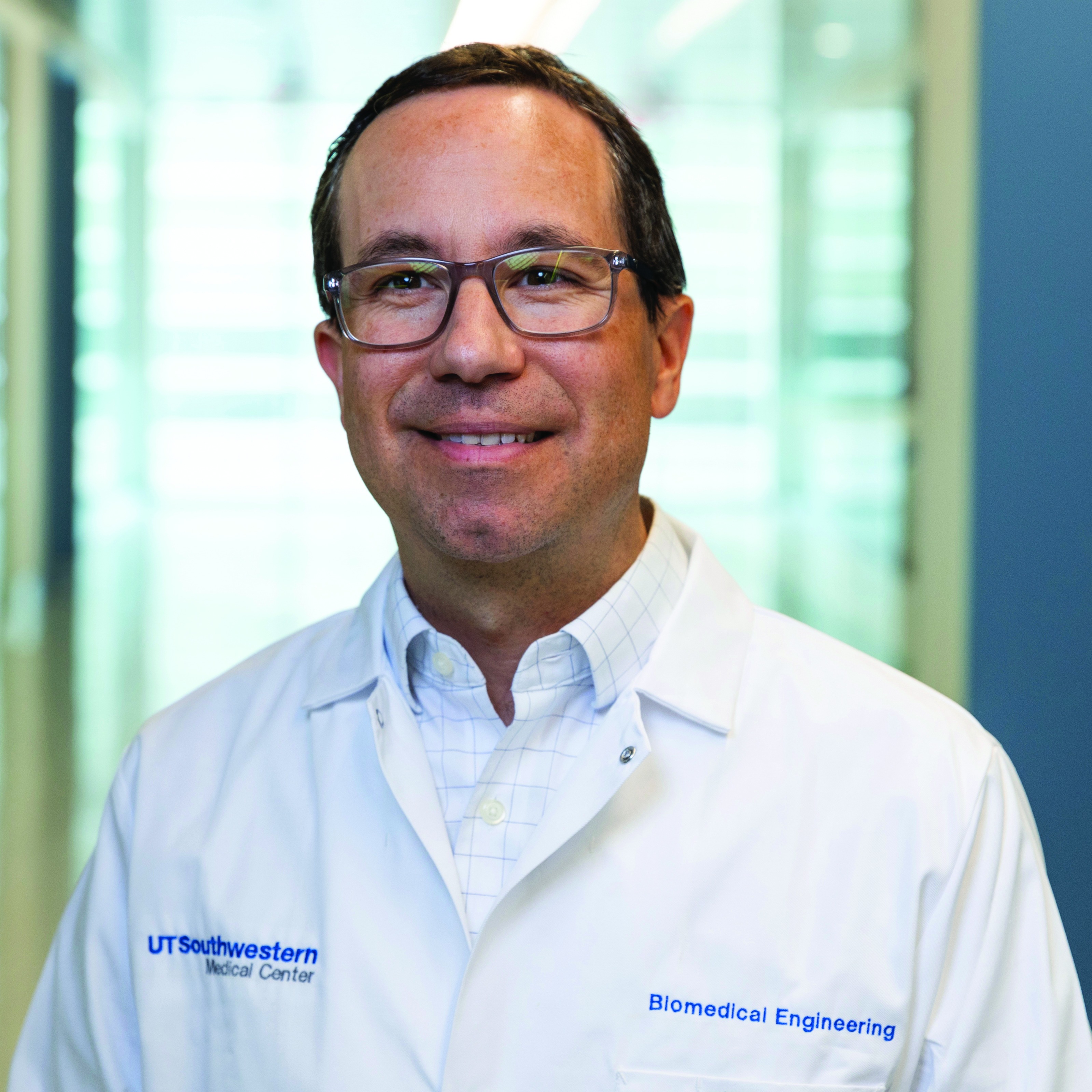
Daniel Siegwart, Ph.D.
Professor, Biomedical Engineering and Biochemistry, Harold C. Simmons Comprehensive Cancer Center
W. Ray Wallace Distinguished Chair in Molecular Oncology Research
Co-Leader, Chemistry and Cancer Research Program, Harold C. Simmons Comprehensive Cancer Center
The son of a construction worker, Dr. Siegwart spent his childhood summers building, remodeling, and roofing alongside his father. He grew up finding solutions, envisioning future states, and learning from missteps to optimize the next project’s results.
His innate drive to learn, solve, and improve flourished after his introduction to chemistry in high school. This problem-solving course of study would serve as the springboard for Dr. Siegwart’s storied career in molecular oncology research at UT Southwestern Medical Center.
Dr. Siegwart is a Professor of Biomedical Engineering and Biochemistry at UT Southwestern and co-leader of the Chemistry and Cancer Research Program in the Harold C. Simmons Comprehensive Cancer Center. He is a National Academy of Inventors Fellow and a National Academy of Medicine Emerging Leader in Health and Medicine Scholar. His work has resulted in more than 100 publications and 300 patents and patent applications worldwide.
In the Siegwart Lab Program in Genetic Drug Engineering, he directs a group that combines a dichotomy of sciences — materials chemistry and problem-solving molecular engineering — to discover new cancer therapies. One goal is to use nanoparticle technology to create anti-cancer medicines that are generated within the human body and eliminate cancer at a molecular level.
“Essentially, we are working to turn the patient’s body into a biofactory to build and implement its own customized cancer treatments,” Dr. Siegwart says. “Instead of producing therapeutic proteins in large bioreactors or creating expensive cell therapies outside the body for future reinfusion, we are aiming to streamline those processes where everything happens inside the body.”
Dr. Siegwart led the research team that reported the first non-viral system for in vivo CRISPR/Cas gene editing. They also developed the Selective Organ Targeting (SORT) system for lipid nanoparticles (LNPs): the first strategy for predictable tissue-specific messenger ribonucleic acid (mRNA) delivery. Recent SORT system innovations from the Siegwart Lab involve genome correction and chimeric antigen receptor T-cell (CAR T) therapies.
SORTing and SENDing Nucleic Acid Medication
Lipids are enigmatic. They attract water at the head but repel it at the tail. They form the bilayers of cells and the organelles within them, but these fatty particles can also self-assemble to become something new, such as a tiny ball of fat that surrounds and transports a targeted cancer drug.
The Siegwart Lab has demonstrated that chemically synthesized LNPs capitalize on these divergent traits to carry anti-cancer drugs to the inside of cells that the drug can’t permeate on its own. Recent research on this stealth maneuver involves the use of SORT technology and nucleic acid drugs to carry mRNA encoded for anti-cancer proteins.
“Lipid nanoparticles have built-in pH-sensitive switches that are derived from synthetic chemistry, allowing them to change their charge inside cells to release the drug molecule,” Dr. Siegwart says. “Using the SORT system, we can control where the nanoparticles accumulate in the body, such as in T cells, to create in situ CAR T-cell anti-cancer therapies.”
In ongoing work, mRNAs encode a therapeutic protein designed to be produced at the injection site — a concept called signal peptide engineered nucleic acid design (SEND) — where the mRNA instructions send the protein to a prescribed destination inside or outside of the cell
“SEND opens up a new world of possibilities,” Dr. Siegwart says. “We may be able to inject these drugs next to a tumor and use healthy cells to produce a cancer-fighting protein, or administer it subcutaneously at home to secrete cancer immunotherapies, such as anti-PD-1 antibodies, for the right length of time.”
CAR T-Cell Therapy via SORT
In 2023, Siegwart Lab researchers reported proof of principle to enhance delivery of CAR T-cell therapy using spleen SORT LNPs.
Current CAR T-cell therapy requires sending the patient’s blood out to a lab, where the patient’s T cells are engineered and shipped back to the hospital. Each step adds time and cost. The Siegwart Lab posed a new question: Could that engineering work be done within the patient’s body instead, using mRNA LNPs?
Pre-clinical research showed that delivering CAR “instructions” to T cells through encoded mRNA via the SORT system extended the lives of mice with B-cell lymphoma and reduced tumor metastasis. In the future, this process could eliminate the need to engineer the cells in labs because the therapy could be generated directly in the patient.
LNP technologies hold promise for treating a wide array of diseases. For example, data from animal and human models of genetic respiratory diseases suggest this process could treat diseases caused by damaged or missing proteins.
“For cystic fibrosis and primary ciliary dyskinesia, data indicate that mRNA LNPs enable lung cells to produce the missing protein,” Dr. Siegwart says. “While our efforts in cancer therapy are more nascent, there are many promising ideas, and some companies are testing mRNA LNP-based cancer immunotherapies in clinical trials.”
Scientific Synergy for Cancer Innovation
Medical oncology research — like chemistry, engineering, and construction work — is a science of identifying problems and building novel solutions. Dr. Siegwart credits his team’s discoveries in part to regularly hosting open discussions with experts in diverse fields.
“Solid scientific ideas and effective plans arise from crosstalk and synergy,” he says. “We bring together chemists, engineers, biologists, medical oncologists, and pharmacologists to talk through ideas. Each specialist brings a different viewpoint and knowledge base to solve the problem.”
Often the solutions that arise do not exist in nature and are typically preceded by a host of attempts that hit obstacles and get tweaked again and again. That push-pull dichotomy and fearlessness keep Dr. Siegwart and his colleagues enthusiastic about the future of cancer treatment.
“In cancer research, we are mentally prepared for possible failure,” he says. “But we always learn something new, and when the breakthrough comes, we cherish that moment, and it keeps us excited to push on to the next challenge.”