
Two Trials, One Common Goal for Glioblastoma

Glioblastoma remains one of the most aggressive and unforgiving diseases in medicine. As the most frequently diagnosed malignant primary brain tumor, it’s devastating and resistant to nearly every conventional therapy brought against it. With median survival rates of less than 18 months, despite maximal treatment, glioblastoma is defined by its grim prognosis. Surgery, chemotherapy, and radiation form the backbone of care, similar to other aggressive cancers, yet their effectiveness is fundamentally limited by the tumor’s biology.
The blood-brain barrier (BBB) blocks many therapeutic molecules from ever reaching their target, while the tumor itself spreads insidiously into surrounding healthy brain tissue, sending microscopic “tentacles” of malignant cells beyond the margins visible on imaging or removable by surgery. This infiltrative behavior makes control extraordinarily difficult and has driven decades of investigation into more creative treatment strategies, particularly those designed to target residual disease. Today, two clinical trials available at UT Southwestern Medical Center are building on that legacy, offering renewed hope for patients and their care teams facing a historically terminal diagnosis.
Beyond the Standard of Care
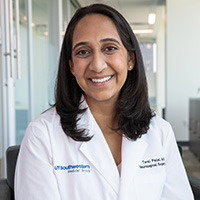
Toral R. Patel, M.D., Associate Professor, Department of Neurological Surgery, UT Southwestern
“Every glioblastoma patient should be evaluated at an academic medical center like UT Southwestern at some point in their health care journey – ideally sooner than later,” said Toral R. Patel, M.D., Associate Professor in UT Southwestern’s nationally ranked Department of Neurological Surgery, where she specializes in brain tumor surgery. “There are clinical trials and treatments beyond the standard of care that are meaningfully changing patient outcomes. And even though this disease may ultimately take a patient’s life, people can live longer with access to some of these newer, novel therapeutics we’re exploring.”
Dr. Patel said her path to neurosurgery began with an interest in engineering in college. During medical school rotations, neurosurgery stood out not only for its technical complexity, but for the human aspect of caring for patients with brain tumors. That intersection ultimately led her to work on clinical trials for glioblastoma.
SONOBIRD Trial at a Glance
Surgery can remove a clearly defined tumor, but operating on normal brain tissue that is intermixed with cancer often causes new neurological deficits and therefore impacts quality of life. The SonoCloud-9 (SONOBIRD) trial addresses that challenge by implanting an ultrasound device into the skull during tumor removal. After surgery, patients receive chemotherapy on an outpatient basis. During each infusion, a needle activates the device, temporarily opening the BBB and allowing the chemotherapy to reach infiltrative tumor cells that would otherwise be shielded.
The SONOBIRD trial includes chemotherapy infusions every three weeks for seven cycles – approximately 20 weeks of active treatment – followed by ongoing monitoring.
ReSPECT-GBM by Comparison
Another trial, ReSPECT-GBM, is a phase two study that uses a catheter-based approach. During surgery, tiny catheters are placed into the brain to deliver nanoparticles carrying a localized radiation source into deeply infiltrative regions of the tumor. The catheters are removed a few days later, and the intervention is completed in a single procedure. Patients are then followed for the remainder of their lives.
“We don’t know which trial will ultimately be more successful,” Dr. Patel said. “We can’t make broad comments about efficacy until the studies are complete and the data is rigorously analyzed. But from a quality-of-life standpoint, patients appear to be tolerating both trials well, which is especially important in a terminal disease.”
The SONOBIRD trial is still actively enrolling, with a planned global enrollment of 560 patients. More than 150 patients have already enrolled worldwide; that number continues to grow as new sites come online. ReSPECT-GBM, which launched earlier, is also continuing to enroll patients.
Early Signals of Hope
“Anecdotally, we’ve seen some long-term survivors we wouldn’t have predicted outside of these trials,” Dr. Patel said. “That suggests there may be a signal that these therapies are working. But until the trials are complete, that remains speculative.”
If successful, these trials could lay the groundwork for future therapies. The devices themselves may ultimately matter as much as what they deliver.
“If we can show that ultrasound helps drugs penetrate into the brain more effectively, we could use this device to potentially deliver a wide array of chemotherapeutics in the future,” Dr. Patel said. “The same is true for catheter-based approaches. These platforms could eventually deliver other drugs, radiation sources, or new therapies. That’s where the real excitement lies – proving the devices work and assuming that the payload will evolve as science advances.”
Clinical trials like these are essential in advancing care and enabling researchers to rigorously evaluate new therapies while giving patients access to groundbreaking treatments today and in the future.